30 December
Please use this form to contact US Sri Chinmoy Centres
To contact individual centres about meditation classes, please use

Art is the embodiment of the unfathomable dance of the soul. –Sri Chinmoy

Working independently of modern art, Sri Chinmoy developed a signature style to chronicle inner meditative experiences: instantaneous abstraction. No parts of the paintings were ever redone, and although completed quickly, they sustain an overall harmony of colour and form. Uninhibited by iconographic or formal restraints, they flow like a fountain with no preconceived mental form. Sri Chinmoy defined Jharna-Kala as a fountain of art: “A fountain is something that comes from within spontaneously, without any outer strain. It is something effortless, easy....When it is a matter of my paintings, there is no mind, no form. It is all fountain-heart; the fountain is constantly flowing.”
As he paints, Sri Chinmoy follows his creative inspiration: “I become an instrument and just follow a streak of light. Here the streak of light indicates creation, beauty.” The streak of light becomes dynamic coloured strokes, surprisingly simple in effect. “My entire art is founded upon a simple, childlike consciousness. Maturity is there, but from the highest point of view, this maturity is all simplicity.”
 Sri Chinmoy first began painting at the Sri Aurobindo Ashram in Pondicherry, India when he was around twelve years old; yet as he says, “I studied a little art in school, around 1944, but I never had real instruction.” Nonetheless, his early works—figurative water colours—create lyrical harmonies characteristic of his mature style.
Nearly thirty years later, Sri Chinmoy spontaneously drew a rose in an Ottawa Hotel, Canada on 19 November 1974 while on a concert tour. The subsequent development of his style was rapid and intense, forming over a period of just few a months. Within a year he had completed 120,000 paintings, finishing as many as 16,031 in 24 hours on 16 November 1975. By 11 December 1977, he had produced 130,388 paintings. During this period he also painted his colossal murals. He continued to paint for another 30 years; the final total came to over 140,000.
With progressive experimentation, Sri Chinmoy arrived at his preferred medium, acrylics, chosen for their translucent brilliance and plastic ease. He tended to use related colour combinations, although he also chose unusual opposites to great effect. Sri Chinmoy always painted on a white background, allowing the colours to stand out, with rare exceptions in his later years.
In search of a diversity of forms, Sri Chinmoy developed an array of painting instruments. These included sponges cut in a variety of unusual shapes, and wands wrapped with cotton and other materials. A brush in the shape of a fan was a particular favourite. He used all sizes, ranging from the most delicate to commercial house-painting brushes. The sizes of his canvases range from tiny frames of just a few inches to huge mural-size paintings of 13’ by 70’. Outdoor murals have been exhibited both in San Francisco and New York. The bulk, however, range from 9” by 12” to 30” by 40”.
 A further addition are the “calendar paintings”, paper printed with a blank calendar format with either 31 daily sections, 12 monthly sections, or four seasonal sections. In each square he would rapidly sponge an image with several chosen colours and then continue from square to square. More than any other format, they illustrate the meaning of unity in multiplicity, multiplicity in unity.
While primarily using watercolour papers, he also painted larger works on canvas, and in later years, on unique handmade papers from Japan, South Africa and Thailand that incorporate natural elements, particularly those of flowers and leaves.
As Sri Chinmoy painted, he would often use rich dabs of dense, opaque colour. The paints were often mixed directly on the canvas through a scumbling effect. These paintings are compact, concentrated, and intense, complete unto themselves. In other paintings, the colours are more translucent, as a fan brush would expand freely into flights of colour. As he blended the paints directly on canvas, they merged into new gradations, generating a luminous effect. Sri Chinmoy also used sponges liberally, incorporating their shape as part of the painting. He would also trail the sponge in long, meandering lines, each with its own distinct rhythm and movement. He commented: “In art, technique is the body and artistic inspiration is the soul.”
While it would seem impossible to characterize 140,000 artworks, many of the paintings unfold as a series. As he did with the calendar grids, Sri Chinmoy would follow a particular theme, a certain shape, brush stroke or colour combination that captured a certain flow on one canvas and would pursue its variations on another. Combined, these ‘theme and variations’ form a series and are usually exhibited simultaneously to indicate the fountain-flow.
In the early 2000s, Sri Chinmoy began adding aphorisms and qualities to his paintings, such as ‘self-transcendence’, or ‘compassion’, coupled with a very distinct style. While visiting China in December 2004, Sri Chinmoy produced multiple watercolour scrolls using traditional Chinese inks, brushes and rice paper (final scroll size: 23.5” by 74”, including silk brocade siding). Each painting had a theme that was translated into Bengali, Chinese, French, German, Italian, Russian and Spanish. His final painting series was entitled ‘World-Harmony’, consisting of numerous 6” by 4.5” miniature acrylics on watercolour paper, dedicated to humanitarian ideals worldwide and exhibited at the United Nations in 2007 - 2008.
First-hand experiences of meditation and spirituality.


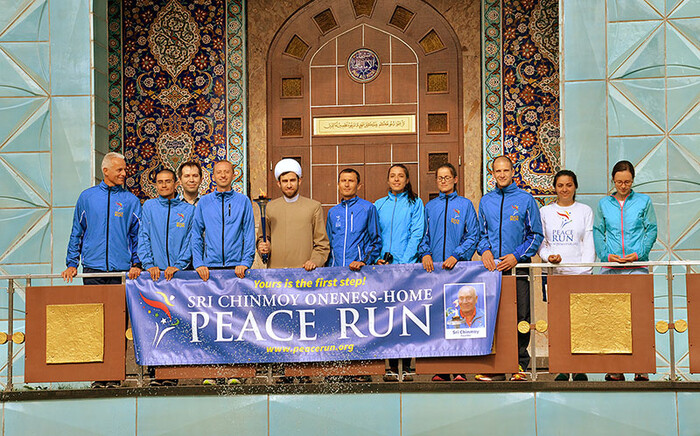


interviews with Sri Chinmoy's students


Except where explicitly stated otherwise, the contents of this site are licensed under a Creative Commons Attribution-NonCommercial-NoDerivs 3.0 Unported License. read more »
SriChinmoyCentre.org is a Vasudeva Server project.


